
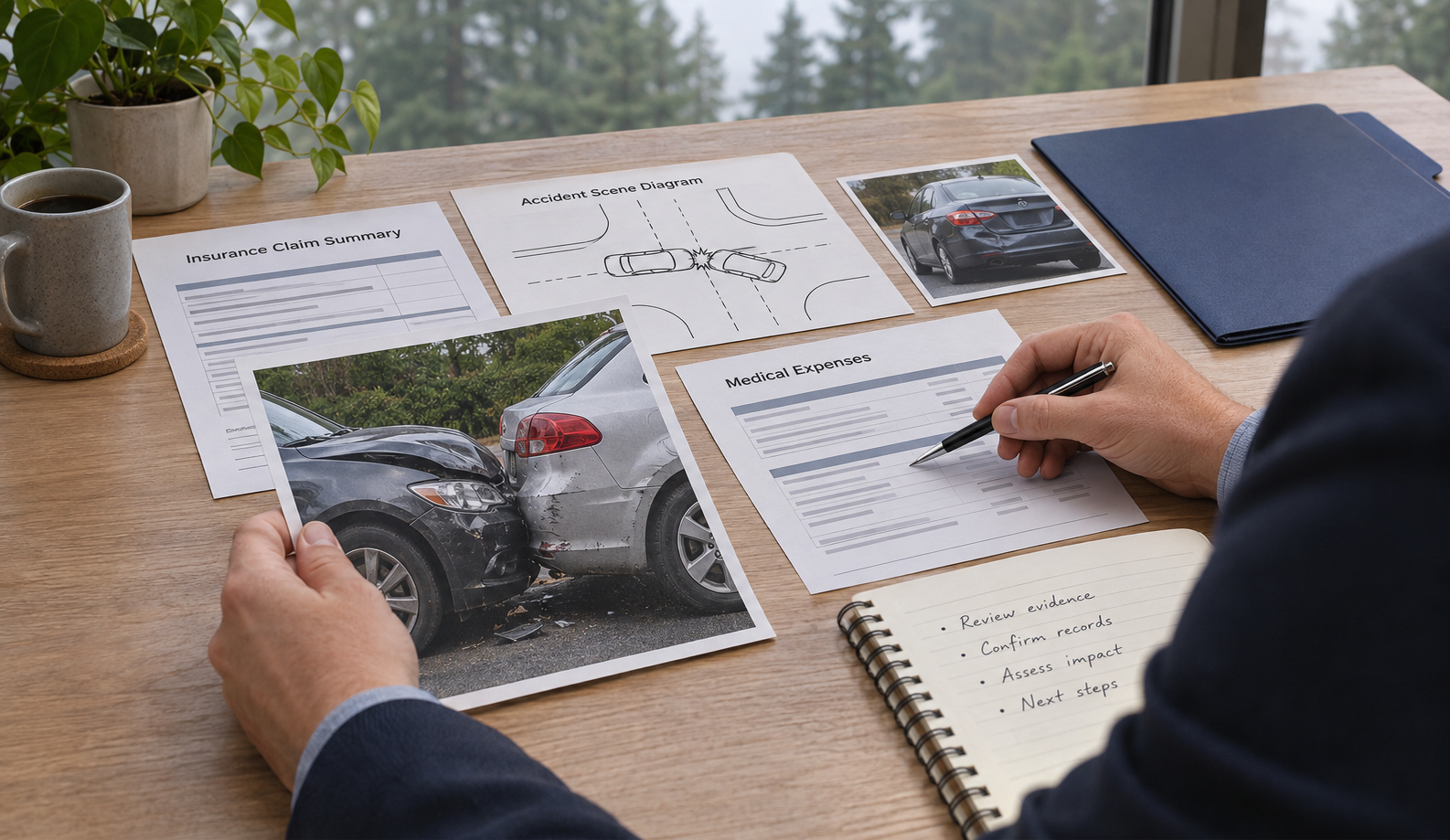
AI-generated illustration; not an actual accident or client matter.
Larry Tran Law LLC
Medical bills after a car accident may involve more than one source of payment. Personal injury protection, or PIP, may pay eligible expenses regardless of who caused the collision. Health insurance and a claim against a responsible driver may also matter. The available coverage depends on the person injured, the policies, and the circumstances. [2]
Identifying where to submit bills can help while the injury claim is being evaluated. An unresolved question about fault does not, by itself, answer whether a bill qualifies for PIP benefits. [2]
What Oregon PIP may cover
Oregon’s required PIP medical benefit generally covers up to $15,000 in reasonable and necessary expenses incurred within two years after the injury. A policy may provide a higher limit. The available medical benefit can run out before those two years end if payments exhaust the limit. [1] [2]
This benefit does not promise payment of every treatment charge. Whether a person and an injury are covered, whether an expense qualifies, and any applicable exclusions still need to be reviewed. [1] [3]
Check the declarations page for the listed PIP limit and ask the insurer for the policy and applicable endorsements if you do not have them. Notify the applicable insurer promptly and obtain the claim number and instructions for submitting bills. [6]
Which auto policy should receive the bills
Coverage may extend to the insured, qualifying household members, passengers occupying the insured vehicle, and pedestrians struck by that vehicle. A collision occurring in Oregon does not alone establish that a particular person or policy has PIP coverage. [3]
For example, the insured vehicle’s PIP benefits are generally primary for its passengers. A passenger’s own applicable policy may provide excess coverage. Priority can differ in other circumstances. [3]
Give the insurers accurate information about whose vehicle you occupied and any other potentially applicable coverage. Ask them to identify which policy should receive the bills first. Keep their responses so the providers have consistent billing information.
Health insurance after PIP
After applicable PIP benefits are exhausted, health insurance may help pay covered expenses. Provider networks, medical-necessity requirements, deductibles, and other cost sharing still matter. A health plan does not necessarily pay every remaining charge. [1] [4]
Ask the auto insurer for written confirmation if the benefits are exhausted. Give that information to the health plan and the providers, and ask what else they need to evaluate the bills.
A denial is different from exhaustion of the available benefits. If PIP payment is denied, keep the written explanation and information about how to contest it. Ask the health plan how it evaluates those bills; do not assume that the denial automatically transfers payment responsibility. [3] [4]
Liability insurance and an injury claim
Medical expenses may also be part of a bodily injury claim against a driver or another party responsible for the collision. The other insurer investigates its insured’s legal responsibility. Opening a claim does not establish that it will pay each bill as it arrives. [1]
This is why reviewing available benefits and pursuing an injury claim can involve separate work. Responsibility for the collision, the connection between the injuries and the crash, and the available insurance may remain disputed while bills are being submitted.
If a responsible driver is uninsured, or the available liability recovery is insufficient to compensate for covered injury damages, uninsured or underinsured motorist coverage may provide another source of recovery. Policy terms, limits, and claim requirements still apply. [2]
Why reimbursement needs review before settlement
PIP or health benefit payments can raise reimbursement questions during the injury claim and when money is recovered. Oregon law limits certain insurer reimbursement claims and provides full-compensation protections. The applicable law, policy, and recovery require review. [3]
Different plans and programs can involve different rules. Some employer health plans fall outside Oregon insurance regulation. Oregon Health Plan members have separate injury-reporting and recovery requirements; OHP may seek reimbursement when a third party is responsible for an injury. [4] [5]
Before resolving the injury claim, identify outstanding bills, amounts already paid, claimed repayment rights, and any effect a release could have on other coverage. The proposed settlement amount alone does not explain how much will remain after those issues are addressed.
Records that help clarify payment
Keep the insurance declarations, claim numbers, itemized medical bills, payment explanations, and denial or exhaustion letters together. For each provider, note what was billed, what was paid or adjusted, and what remains unresolved. Save correspondence with insurers and billing offices so the sequence can be reconstructed.
You do not need to finish treatment or assemble every record before asking whether the firm can review your inquiry. Start with the accident date and location, the available insurance information, and a brief description of the unpaid or disputed bills.
The two-year period for eligible PIP medical expenses is not the deadline for every claim or required notice. Filing periods, notice requirements, and insurance deadlines should be evaluated promptly. [7] [8]
Discuss an Oregon car accident injury with Larry Tran Law
Larry Tran Law evaluates injury inquiries involving Oregon car accidents. We consider inquiries from Oregon residents and people who live elsewhere but were injured in Oregon. Learn more on our Oregon Car Accident Attorney page.
To ask whether the firm can assist, call 971-480-2100 or send a brief inquiry. Please provide only contact information and a brief, nonconfidential description initially. Sending an inquiry does not, by itself, create an attorney-client relationship. The firm must complete its screening and agree to the representation.
Do not delay protecting an applicable filing or notice deadline while awaiting a response.
Larry Tran Law LLC | 971-480-2100
This article provides general information and is not legal advice for a particular matter.
Sources
1. Oregon Division of Financial Regulation — Car insurance FAQs
2. Oregon Division of Financial Regulation — Questions about PIP and uninsured motorist coverage
3. ORS 742.520–742.544 — PIP eligibility, benefits, priority, denials, and reimbursement
4. Oregon Division of Financial Regulation — Top 10 health insurance myths
5. Oregon Department of Human Services — Personal Injury Liens
6. Oregon Division of Financial Regulation — What to do if you are in an accident
7. ORS 12.110 — General limitation period for specified personal injury actions
8. ORS 30.275 — Notice and timing requirements for public-body claims