
FACTA Receipt Violations • TCPA Robocalls & Texts • Consumer Protection
Businesses have legal obligations when handling your payment information and contacting you. When the same unlawful practice affects many consumers, a class action may provide a way to pursue accountability together.
Larry Tran Law evaluates individual and potential class action claims involving improperly printed credit and debit card receipts, unlawful robocalls and marketing texts, and other consumer protection violations.
Oregon Class Action Attorney
FACTA: Credit & Debit Card Receipt Violations
Does your receipt reveal too much of your card information?
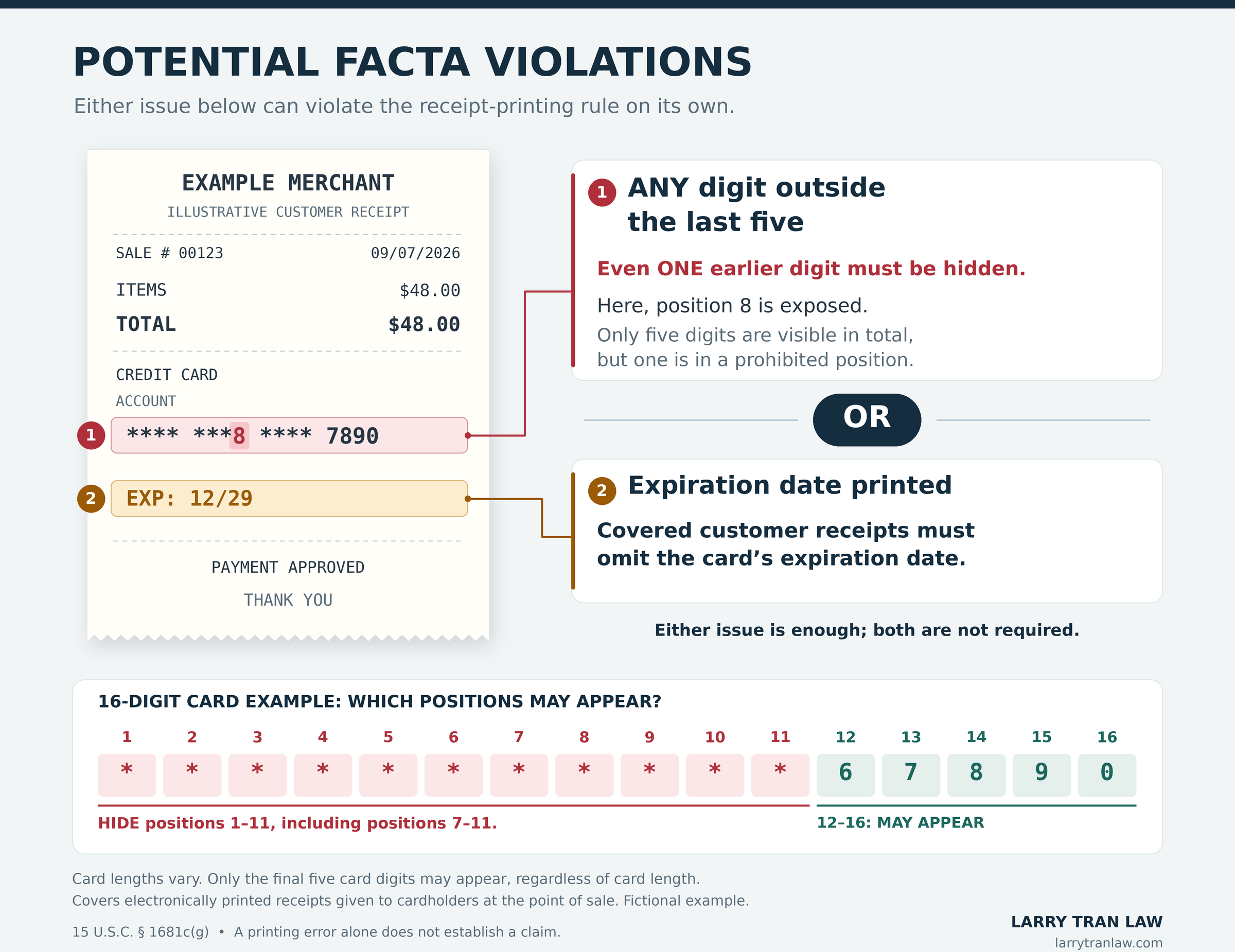
The Fair and Accurate Credit Transactions Act (FACTA) limits the payment-card information businesses may print on customer receipts. For covered receipts, businesses must:
Hide all card-number digits except, at most, the final five.
Omit the card’s expiration date.
These requirements apply to electronically printed receipts provided to the cardholder at the point of sale or transaction. 15 U.S.C. § 1681c(g).
Receipt Problems We Evaluate
We review customer receipts displaying:
A complete credit or debit card number.
More card-number digits than the law permits.
The first six digits together with the last four digits.
A card expiration date or partial expiration information that warrants further review.
Receipts from stores, restaurants, hotels, parking facilities, and other businesses may warrant examination. The receipt’s format and the circumstances of the transaction matter.
These federal printing requirements cover customer receipts; exceptions apply to handwritten or manually imprinted records, and the restriction does not govern copies a business retains solely for its own records. FTC explanation of receipt requirements.
Potential Compensation for FACTA Violations
For proven willful noncompliance, the law permits actual damages or statutory damages ranging from $100 to $1,000, along with potential punitive damages. Successful claims may also support recovery of court costs and reasonable attorney’s fees. 15 U.S.C. § 1681n.
Recovery depends on the evidence and applicable legal requirements. A receipt-printing error alone does not guarantee compensation.
Could Your Receipt Reveal a Broader Problem?
A receipt may reflect a payment-system setting used across many transactions or locations. We investigate whether the same printing practice affected other customers and whether the evidence supports pursuing a class action.
You do not need to gather other customers before contacting us.
Preserve Your Receipt
If you received a receipt that appears to expose excessive card information:
Keep the original receipt intact and stored securely.
Take a clear photograph or scan before the print fades.
Note the business name, location, and transaction date.
Preserve related purchase records and communications.
Contact us to discuss what happened and how to provide the relevant records.
Can I Contact You If I Have Not Experienced Identity Theft?
Yes. We can review your receipt and circumstances even if you have not discovered fraudulent charges.
Whether a lawsuit can proceed requires further analysis. Federal courts require a concrete injury beyond a bare statutory violation; the information disclosed and any resulting harm matter. Bassett v. ABM Parking Services.
Discuss Your FACTA Claim
Contact Larry Tran Law to discuss what happened and whether you may have a claim.
Request a Case Review
Phone: 971-480-2100
Email: info@larrytranlaw.com
Sending an inquiry does not, by itself, create an attorney-client relationship. Please do not send confidential information until we have completed a conflict check and confirmed that we can discuss your matter.
Robocall & Text Message Claims We Evaluate
Prerecorded & AI-Generated Calls
Calls using recorded sales pitches, artificial voices, or AI-generated voices without the legally required consent. These voice technologies can trigger TCPA protections even when the caller does not use a regulated autodialer. FCC guidance on artificial voices.
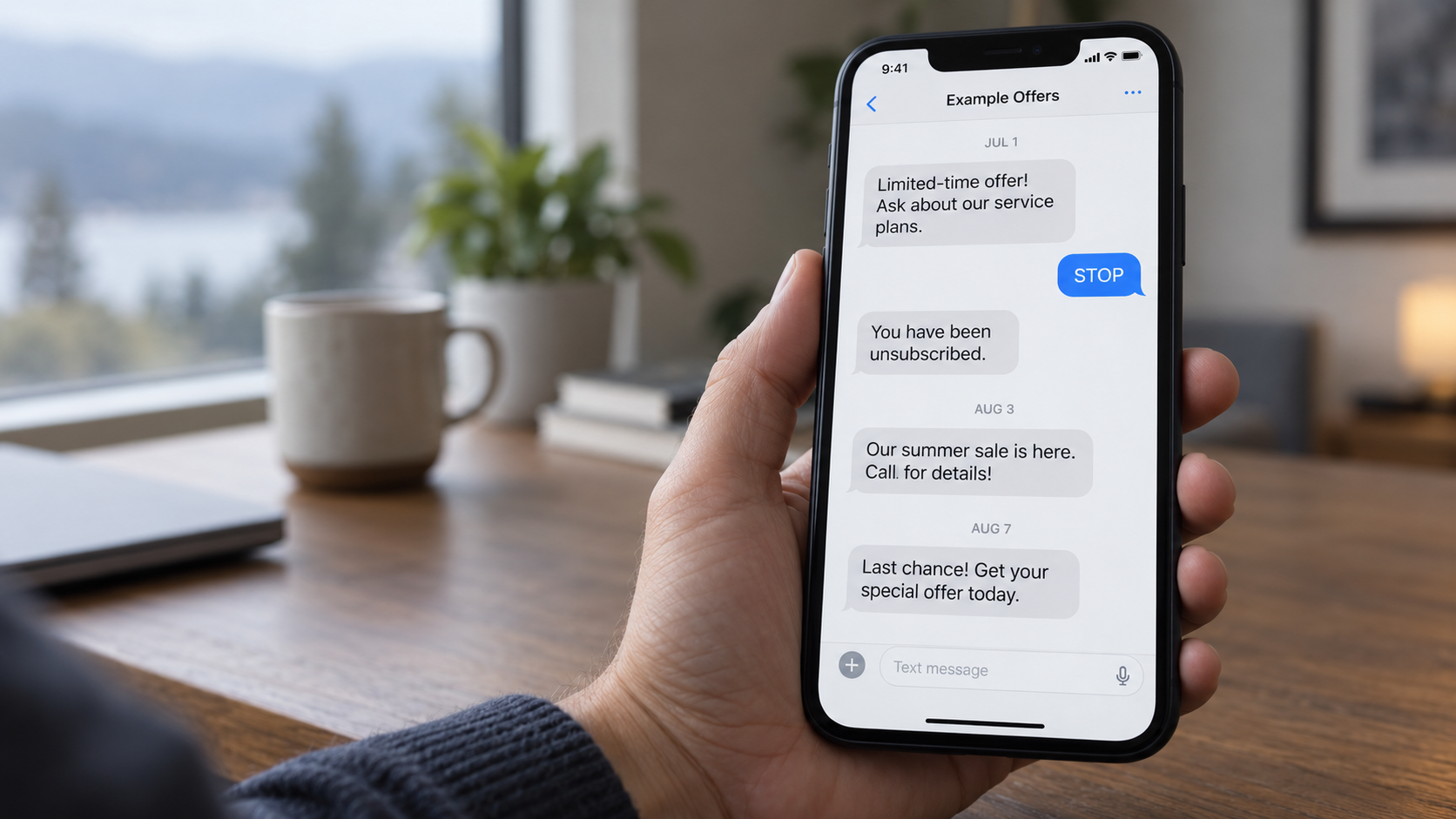
Unwanted Marketing Texts
Promotional texts sent without required consent or in violation of applicable Do Not Call protections. We review the messages, how they were sent, and any permission the sender claims you provided.
Calls & Texts After You Asked Them to Stop
Continued communications after you replied “STOP,” requested removal from a calling list, or otherwise withdrew consent. We examine the request, its scope, and when the company received and honored it.

Do Not Call Violations
Repeated telemarketing contacts to eligible numbers on the National Do Not Call Registry, or after a company-specific do-not-call request. These protections can apply to live sales calls as well as automated communications. Consent, exceptions, and other requirements affect whether a claim exists. Federal calling and texting rules.
Marketing Through Lead Generators & Call Centers
Calls and texts promoting insurance, mortgages, solar installations, vehicle warranties, home improvements, debt relief, and other products or services.
We investigate who initiated the communications, whose products were promoted, and which businesses may be legally responsible.
What Compensation May Be Available?
Depending on the claim, the TCPA provides for:
$500 per violation for qualifying robocall or robotext violations.
Up to $500 per violation for qualifying Do Not Call claims.
Increased statutory damages of up to $1,500 per violation when a court finds a knowing or willful violation and exercises its discretion to increase the award.
Certain Do Not Call claims require more than one violating call within a 12-month period from or on behalf of the same entity. Recovery depends on the applicable law, evidence, and circumstances; these amounts are not guaranteed payments for every unwanted call or text. 47 U.S.C. § 227.
When Can a TCPA Case Become a Class Action?
A company’s calling or texting campaign may affect many people through the same practices. A class action can allow qualifying claims to proceed together through one or more representatives.
Whether a case can proceed as a class action depends on the evidence and legal requirements, including the similarities among the claims and whether the proposed representatives can adequately protect the group’s interests. The court decides whether to certify the class. Federal Rule of Civil Procedure 23.
Larry Tran Law evaluates whether your circumstances support an individual claim, a potential class action, or another appropriate approach.
How We Evaluate Your Claim
We review:
The communications: Call logs, voicemails, complete text conversations, dates, and frequency.
The sender: Business names, advertised products, callback numbers, and identifying details.
Consent and opt-outs: Forms, prior transactions, permission language, and requests to stop.
Potential patterns: Whether the same campaign or practice affected other consumers.
You do not need to identify every responsible company or gather a group of other recipients before contacting us.
Save Your Calls, Texts & Voicemails
Preserve the information you already have:
Screenshots showing the complete message, sender, date, and time.
Original text conversations and voicemail audio.
Call histories and available phone bills.
Your opt-out requests and any responses.
Relevant emails, signup forms, and Do Not Call registration confirmations.
Keep records before deleting messages or replacing your phone. Save any business names or callback numbers provided—the number displayed on caller ID may be spoofed. FTC information on unwanted calls.

Frequently Asked Questions
Does every unwanted call or text violate the TCPA?
No. The applicable restrictions depend on factors such as consent, the communication’s purpose, and the technology used. A text being sent automatically does not, by itself, establish use of an autodialer covered by the TCPA. Facebook v. Duguid.
What if I previously gave the company my phone number?
That does not resolve whether every later communication was lawful. We review what permission you gave, which communications it covered, and whether you later withdrew it. Federal consent rules.
What if I do not know who is behind the calls?
Start with what you have. Messages, voicemails, advertised services, and follow-up communications may help identify the businesses involved. We can assess whether further investigation is practical.
Other Consumer Class Actions
The firm also evaluates potential consumer class actions involving deceptive business practices, unlawful charges, and similar conduct affecting groups of consumers.

Discuss Your Robocall or Text Message Claim
Receiving repeated unwanted calls or texts? Contact Larry Tran Law to discuss what happened and whether you may have a claim.
Request a Case Review
Phone: 971-480-2100
Email: info@larrytranlaw.com
Sending an inquiry does not, by itself, create an attorney-client relationship. Please do not send confidential information until we have completed a conflict check and confirmed that we can discuss your matter.
Contact Us
Share your contact information and a brief description of your matter. Let us know what happened, approximately when it happened, and what help you are seeking.
Please keep your initial message brief. Do not include Social Security numbers, payment card numbers, medical records, or other sensitive documents.
Sending an inquiry does not, by itself, create an attorney-client relationship. Please do not send confidential information until we have completed a conflict check and confirmed that we can discuss your matter.