
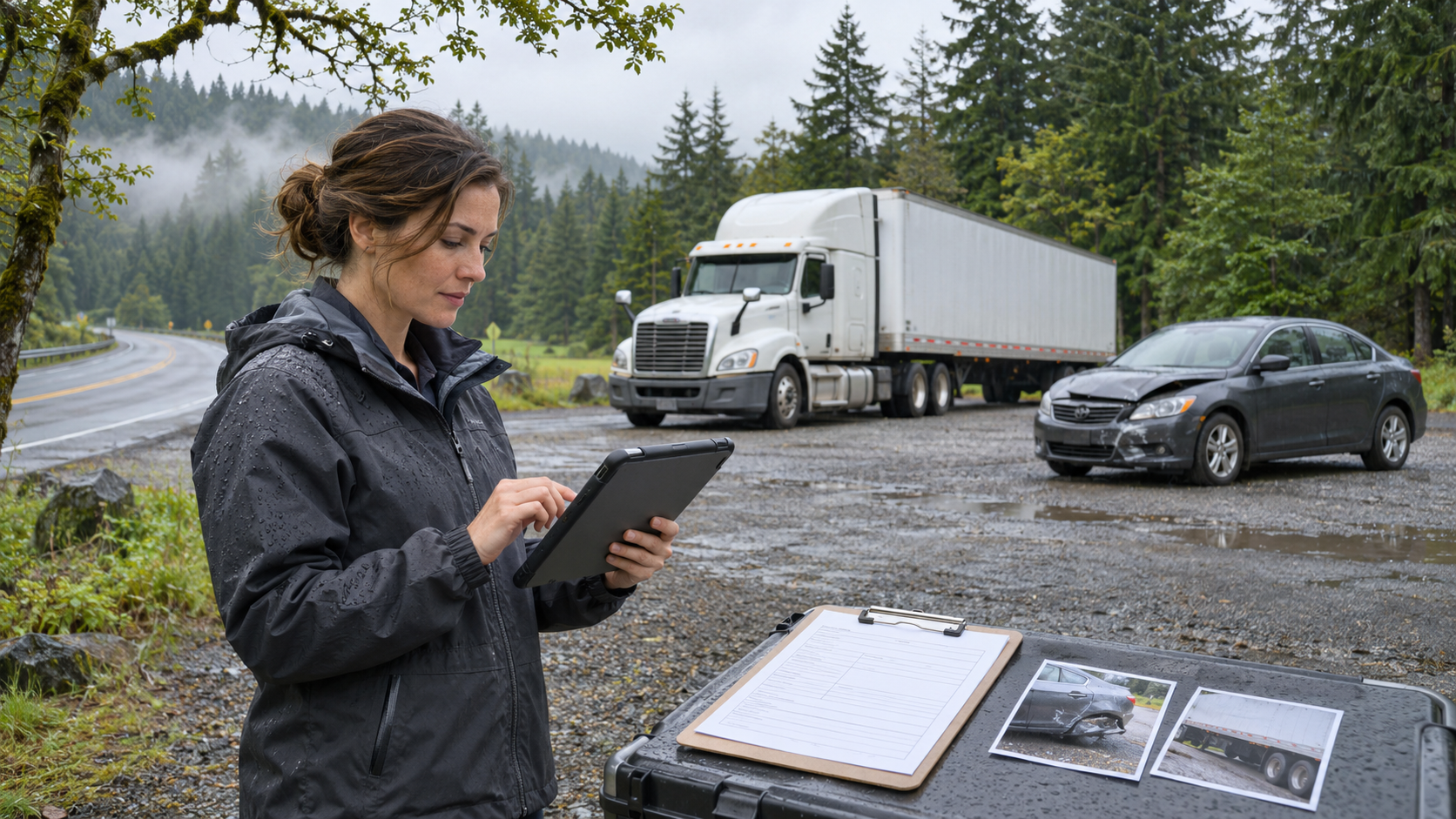
AI-generated illustration. Not an actual accident or client matter.
Investigating a truck accident in Oregon can involve records held by a driver, a trucking company, a repair shop, or a business near the collision. Those records may help explain the driver's schedule, the condition of the vehicle, and how the crash occurred.
Three categories worth considering are driver records, inspection and maintenance records, and photos, video, and electronic data. The records available and the rules requiring them depend on the vehicle, its operation, and the circumstances of the collision.
1. Driver records
Driver records can provide information about a driver's qualifications and work before the collision. For carriers subject to the applicable federal rules, a driver qualification file includes materials such as employment applications, driving-history records, and documentation of required driving-record reviews or road-test certification. [1]
Hours-of-service records address a different question: when the driver was driving, performing other work, or off duty. Where required, electronic or paper duty-status records can be compared with dispatch messages, trip records, and delivery documents to help reconstruct that schedule. [2] [3]
For example, a delivery schedule and dispatch communications may help an investigator examine whether the driver's reported timeline is consistent with other records. That comparison may identify questions requiring further investigation; the records must be considered with the other evidence when assessing whether fatigue or another factor contributed to the collision.
The applicable requirements vary. Some drivers qualify for exceptions to electronic logging or duty-status recordkeeping, so an investigation should not assume that every delivery van or work truck has the same records. [2] [4]
2. Inspection and maintenance records
The condition of a commercial vehicle may be part of the investigation. Inspection reports, maintenance records, repair invoices, and reports of mechanical problems can help establish what was known about the vehicle before the crash.
Federal rules require covered carriers to inspect, repair, and maintain vehicles under their control. For vehicles subject to the recordkeeping requirements, the records include the nature and dates of inspections, repairs, and maintenance. [5]
If the evidence raises a question about braking or steering, for example, earlier complaints and repair records may help identify when a problem was reported and what work followed. A qualified vehicle inspection may help determine whether the condition existed before the collision or resulted from the impact.
The connection to the crash matters. A maintenance entry or a prior defect does not, by itself, establish who caused the collision. The records need to be evaluated alongside the vehicle's condition and the other available evidence.
3. Visual and electronic evidence
Photographs can document vehicle damage, debris, lane markings, signs, visibility, and roadway conditions. Available dashcam or nearby surveillance footage may show vehicle movements before the impact. A camera's presence does not establish that it recorded the collision or that footage remains available. [6]
Depending on the vehicle and equipment, onboard systems may also contain information about speed, braking, or other vehicle activity. What is recorded, what survives, and how it should be interpreted vary by system. Qualified technical assistance may be needed to preserve and evaluate that information. [7]
An electronic logging device, or ELD, serves a different purpose. Its required functions concern driving and duty status. FMCSA explains that ELDs are not required to record speed, braking, or steering. A device that also provides fleet-management features may have additional capabilities, but those should be verified rather than assumed. [8]
If you already have relevant photos or video, preserve the original files and keep backup copies. Retain the complete recording, including the portion before and after the collision, rather than keeping only an edited clip.
Why preserving evidence promptly can matter
Some electronic information can be overwritten or lost, and a damaged vehicle may be repaired, moved, or disposed of. An early review can help identify who may hold relevant evidence and whether inspection or preservation steps should be considered. [7]
Different records have different retention requirements. For example, the federal rule for certain required driver duty-status records and supporting documents calls for retention for at least six months from receipt. That period is not the deadline to file an injury claim and should not be treated as a reason to wait. [2]
A preservation request can identify records or physical evidence to be kept. It does not guarantee that the material exists or will be produced. Obtaining records held by another person or business may require additional legal steps.
What you can keep now
Keep the materials already available to you, such as photographs, original video files, witness contact information, the collision report number, insurance correspondence, and vehicle repair or towing records. Medical and wage records may also be relevant to documenting the effects of an injury.
If you noticed a business or vehicle that may have recorded the collision, note its location or identifying information. You do not need to assemble every record before speaking with an attorney about what evidence may matter.
Discuss an Oregon truck accident with Larry Tran Law
Larry Tran Law evaluates injury inquiries involving Oregon collisions with semi-trucks, delivery vans, work trucks, and other commercial vehicles. We consider inquiries from Oregon residents and people who live elsewhere but were injured in Oregon.
For more information about the matters we evaluate, visit our Oregon Truck Accident Attorney page. To discuss your situation, give us a call at 971-480-2100 or send a brief inquiry.
Please provide only your contact information and a brief, nonconfidential description of the matter initially. Sending an inquiry does not, by itself, create an attorney-client relationship. Do not delay protecting an applicable filing or notice deadline while awaiting a response.
This article provides general information and is not legal advice for a particular matter.
Sources
1. 49 CFR 391.51 — Driver qualification files
2. 49 CFR 395.8 — Driver records of duty status
3. 49 CFR 395.11 — Supporting documents
4. FMCSA — General information about the ELD rule
5. 49 CFR 396.3 — Inspection, repair and maintenance
6. NHTSA — Special Crash Investigations
7. Transport Canada — Heavy vehicle event data recorders best practices (Cited for technical background on North American heavy-vehicle data systems, not as a statement of Oregon or U.S. legal requirements.)