
Oregon Federal Jury Returns $26.48 Million Verdict in Commercial-Vehicle Crash Case
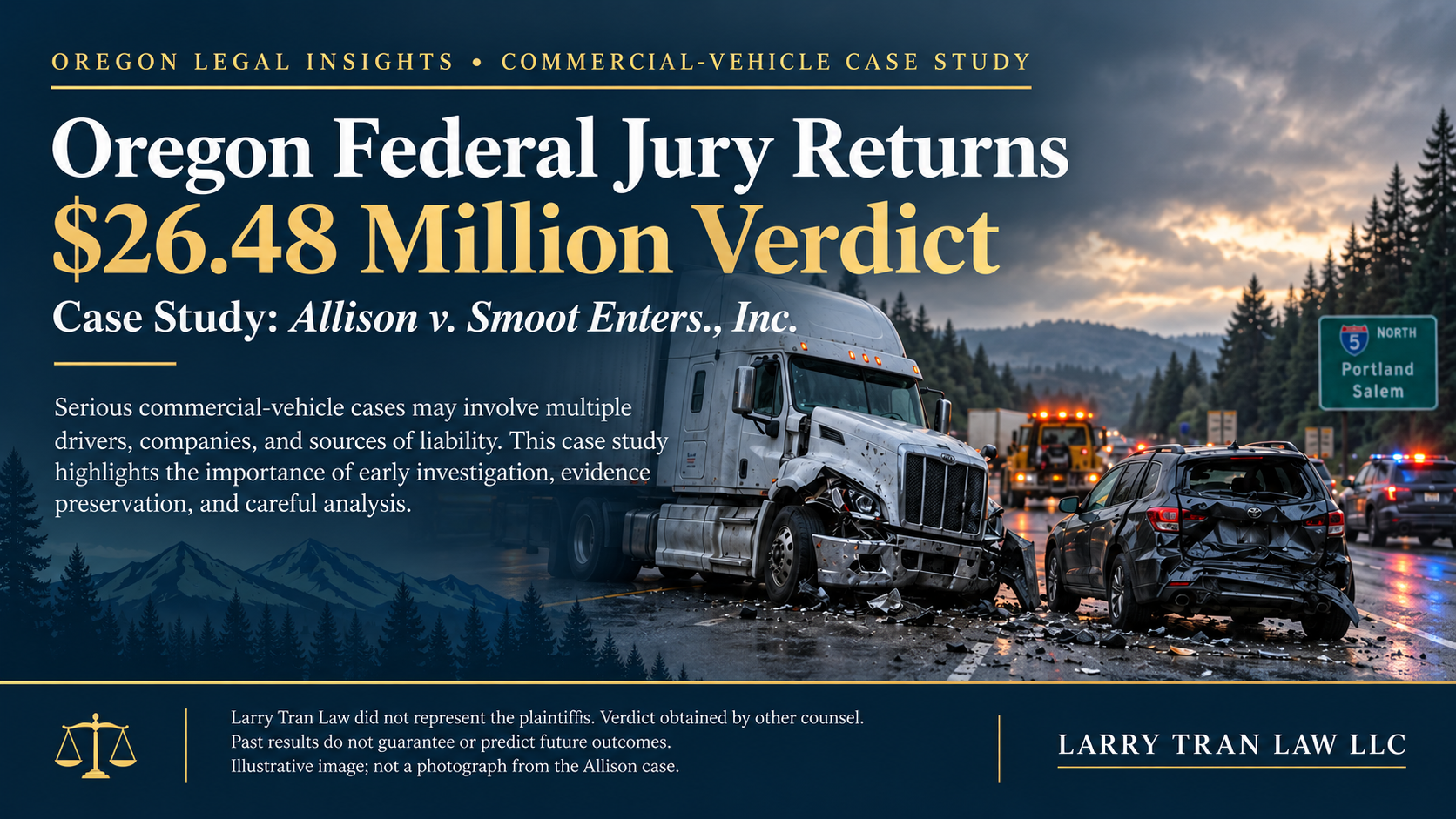
A serious commercial-vehicle crash is not always a case involving only the driver whose vehicle made contact with the injured person.
Depending on the facts, an investigation may identify several individuals, companies, insurance policies, or other sources of potential responsibility.
Allison v. Smoot Enterprises, Inc., an Oregon federal case arising from a catastrophic collision in Eastern Oregon, illustrates why determining what happened before a commercial-vehicle crash, and who may be legally responsible, can matter.
Following a jury trial held from April 30 through May 10, 2019, the jury returned a verdict totaling $26,483,463.
Larry Tran Law did not represent the plaintiffs in this case. The verdict was obtained by other attorneys in a separate matter and is discussed here for general informational purposes. Past results do not guarantee or predict the outcome of another case.
What Happened?
The collision occurred on June 5, 2016, on U.S. Highway 20 in Eastern Oregon.
The case involved drivers associated with two transportation companies: Smoot Enterprises, Inc., doing business as Smoot Brothers Transportation, and Horizon Transport, Inc.
According to the litigation record and reporting concerning the case, commercial drivers had engaged in an extended series of aggressive driving encounters before the collision. Ultimately, a Smoot vehicle driven by James DeCou entered the opposing lane while attempting to pass.
Sara and Matthew Allison were traveling in the opposite direction.
The vehicles collided head-on.
Sara Allison was killed, and Matthew Allison suffered significant injuries.
The lawsuit did not focus exclusively on the driver whose vehicle physically collided with the Allisons. Claims were pursued against multiple defendants associated with the events leading to the crash.
That broader examination of the circumstances became an important part of the litigation.
The Jury Returned a $26,483,463 Verdict
On May 10, 2019, the jury found the named defendants jointly liable for the plaintiffs' damages.
The jury awarded Matthew Allison:
$600,000 in economic damages
$7,000,000 in noneconomic damages
Sara Allison's estate was awarded:
$2,383,463 in economic damages
$10,000,000 in noneconomic damages
The jury also awarded punitive damages totaling $6.5 million:
$5 million against Horizon Transport, Inc. and Jonathan Hogaboom, and
$1.5 million against Smoot Enterprises, Inc. and James DeCou.
The total jury verdict was:
$26,483,463
The verdict amount should not be confused with the amount ultimately recoverable from any particular defendant. When the court later entered judgment, it applied offsets for amounts previously paid under a settlement involving Smoot.
Horizon Transport and Jonathan Hogaboom subsequently asked the federal court for a new trial or, alternatively, a reduction of the damages award through remittitur.
The court denied that motion.
Why Commercial-Vehicle Cases Can Be Different
Depending on the circumstances, a serious commercial-vehicle collision may require investigation beyond the immediate impact itself.
Questions may include:
What happened in the minutes or hours before the collision?
Were other drivers or vehicles involved in creating the dangerous situation?
Was the commercial driver properly qualified?
What company employed or controlled the driver?
What instructions, policies, or communications may have affected the driver's conduct?
Was the commercial vehicle properly inspected and maintained?
Were multiple companies or insurance policies involved?
Those questions will not be relevant in every case. But when the circumstances warrant it, identifying the complete chain of events can materially affect the investigation.
Evidence May Exist Beyond the Police Report
Commercial-vehicle cases may also involve sources of evidence that are not present in an ordinary passenger-vehicle collision.
Depending on the vehicle and company involved, potentially relevant evidence may include:
Electronic logging or driving records;
Electronic vehicle or engine data;
Dash-camera or onboard video;
Dispatch communications;
Driver qualification and employment records;
Inspection and maintenance records;
Company policies and training materials;
Cellular or electronic communications; and
Insurance and contractual records.
Not every commercial vehicle will have all of these materials, and not every category will be relevant in every case.
Some electronic information may also be routinely overwritten or lost with the passage of time. For that reason, identifying and preserving potentially relevant evidence can be an important early consideration after a serious commercial-vehicle collision.
The Driver May Not Be the Only Potentially Responsible Party
People injured in a crash often begin with an understandable assumption: the claim is against the driver who caused the collision.
Sometimes that is correct.
But depending on what the evidence establishes, other individuals or entities may also bear legal responsibility.
Those parties can potentially include an employer, motor carrier, vehicle owner, contractor, maintenance provider, manufacturer, or another driver or company whose conduct contributed to the collision.
The available insurance picture may also be more complicated than a single automobile liability policy.
Determining who may be responsible requires examining the actual facts, relationships among the parties, applicable law, and available evidence. The presence of a commercial vehicle does not by itself establish liability against a company or any additional party.
A Serious Injury Claim Involves More Than Medical Bills
Medical expenses are an important part of many personal-injury claims, but they may not reflect the entire effect of a catastrophic injury.
Depending on the evidence and applicable law, damages can potentially involve matters such as:
Past and future medical expenses;
Lost income;
Reduced future earning capacity;
Physical pain;
Emotional harm;
Permanent impairment or disability; and
Interference with ordinary activities and quality of life.
A wrongful-death case involves different categories of loss governed by Oregon law.
Punitive damages are also not available merely because an accident caused severe harm. They arise only in circumstances satisfying the applicable legal requirements for punitive damages.
The Allison verdict illustrates how a jury may evaluate different categories of loss in a catastrophic commercial-vehicle case, but it does not establish what another injury or wrongful-death case is worth.
Evaluating an Oregon Truck or Commercial-Vehicle Crash
A careful investigation of a serious commercial-vehicle collision may involve more than determining whether another driver received a citation or carried insurance.
Among the questions that may need to be evaluated are:
What caused the collision?
Who may be legally responsible?
What evidence exists and what needs to be preserved?
What insurance coverage may apply?
What injuries and losses can be supported by the evidence?
Every collision presents different facts, parties, insurance issues, injuries, and legal questions.
Larry Tran Law represents clients in Oregon personal-injury matters, including motor-vehicle and commercial-vehicle collision cases.
To discuss whether a matter may be appropriate for the firm, you may contact Larry Tran Law at 971-480-2100, email info@larrytranlaw.com, or submit an inquiry.
About the Case
Allison v. Smoot Enters., Inc., No. 2:17-cv-01598-SU, 2019 WL 5095779 (D. Or. Oct. 11, 2019).
The jury returned its verdict on May 10, 2019. The federal court's October 11, 2019 Opinion and Order denied Horizon Transport, Inc. and Jonathan Hogaboom's motion for a new trial or, alternatively, remittitur. The court's opinion also explains that judgment had been entered with offsets for amounts previously paid in settlement.
Larry Tran Law did not represent Matthew Allison, Sara Allison's estate, or any other party in the Allison litigation. The verdict described in this article was obtained by other attorneys in a separate matter. Past results do not guarantee or predict the outcome of another case. Every matter depends on its particular facts, evidence, parties, damages, insurance, procedural posture, and applicable law. This article provides general information only and is not legal advice. Reading this article or contacting Larry Tran Law does not by itself create an attorney-client relationship.
Larry Tran Law LLC
Larry Tran, Attorney
Oregon State Bar No. 264279
Personal Injury • Timber Trespass • Class Actions
971-480-2100
larrytranlaw.com