
Butori v. Bosma: $810,000 in Oregon Timber-Trespass Treble Damages
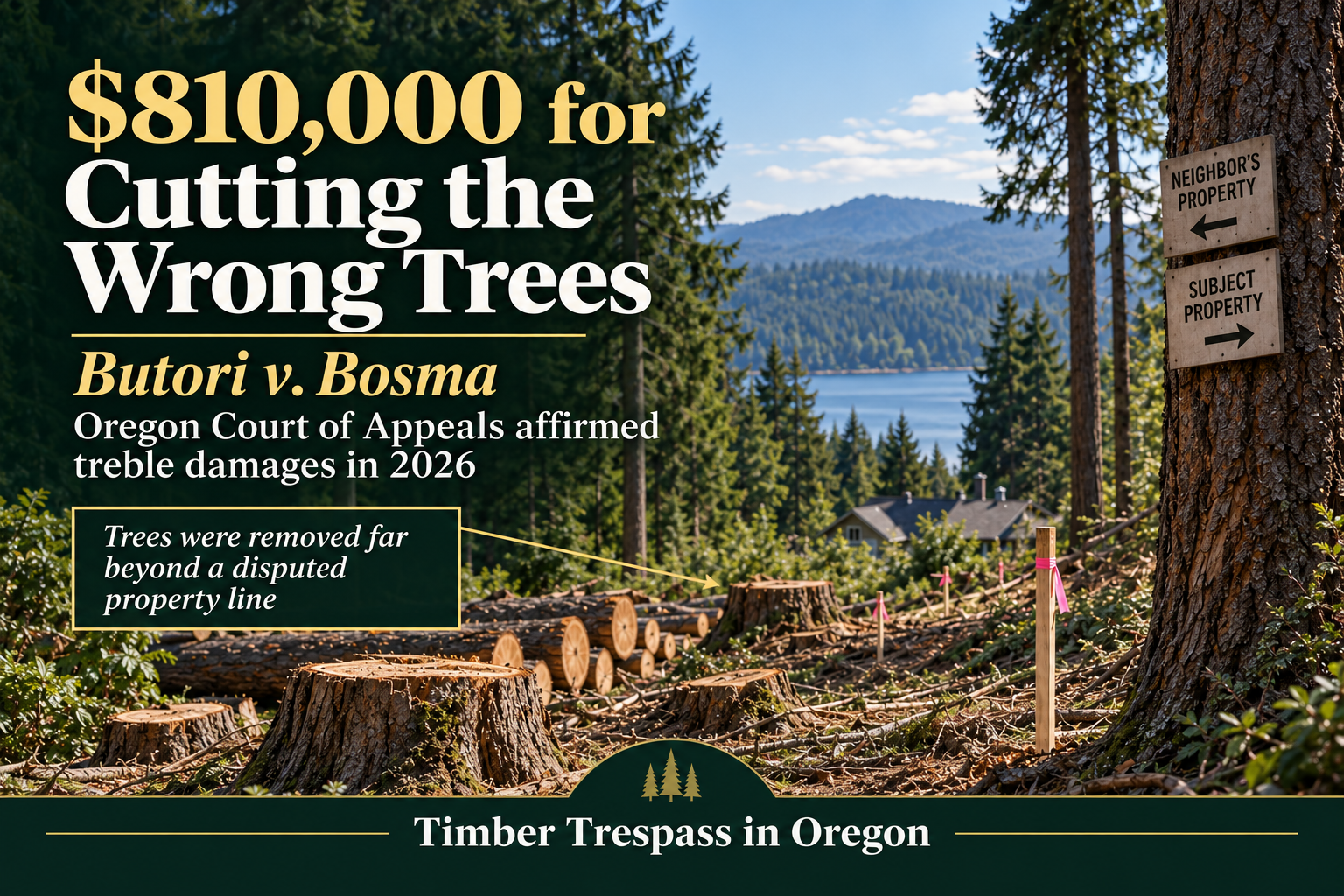
Illustrative image — not a photograph from Butori v. Bosma.
A property-line dispute can become very expensive when trees are cut before the boundary is resolved.
In Butori v. Bosma, 348 Or App 278 (2026), the Oregon Court of Appeals affirmed a judgment awarding a property owner $810,000 in treble damages after a jury found that the defendants willfully or intentionally committed timber trespass. The decision illustrates how boundary evidence, prior notice of a property dispute, and the conduct of the people directing the cutting can become critical in an Oregon tree-damage case.
Larry Tran Law did not represent the parties in this case. The judgment discussed below was obtained by other attorneys in a separate matter and is presented for general informational purposes. Past results do not guarantee or predict the outcome of another case.
What Happened
The plaintiff, Tom Butori, and Bosma Enterprises owned neighboring parcels identified as government Lots 6 and 7.
According to the Court of Appeals, Butori alleged that Henry Bosma hired a construction company to perform work on the neighboring property in 2018. During that work, trees, shrubs, and other vegetation were removed from an area that Butori contended was approximately 150 feet beyond the property line and on his land.
The defendants disputed where the boundary was located and presented competing evidence concerning the property line. The jury ultimately found for Butori and determined that the timber trespass was willful or intentional. The resulting judgment awarded $810,000 in treble damages.
What the Oregon Court of Appeals Decided
The defendants appealed and challenged several rulings made during the trial.
They argued that the trial court improperly admitted testimony concerning the property boundary, that evidence involving an earlier timber-trespass settlement between the parties should not have been admitted, and that there was insufficient evidence to permit Henry Bosma to be held personally liable.
The Oregon Court of Appeals rejected those arguments and affirmed the judgment.
Two parts of the decision are particularly important for Oregon property owners.
Why the Earlier Boundary Dispute Mattered
This was not the first disagreement between these neighbors involving timber trespass near the disputed property line.
At trial, the plaintiff introduced evidence concerning a settlement of an earlier timber-trespass dispute involving the same general area. Ordinarily, evidence of a settlement cannot simply be used to prove that someone was liable in the later case.
That was not how the evidence was used here.
The trial court allowed a redacted version of the earlier settlement because it tended to show that the defendants already knew there was a disagreement concerning the property boundary. The amount paid in the prior settlement was removed, and the jury was specifically instructed that it could consider the evidence only in deciding whether the later conduct was willful or intentional rather than casual or involuntary.
The Court of Appeals upheld that ruling.
The distinction matters. The prior settlement was not admitted to prove that the defendants had committed the new trespass. It was relevant because prior knowledge of a boundary disagreement could bear on whether later cutting was truly a mistake.
For property owners, the practical lesson is significant: documents showing that a neighbor had prior notice of a disputed boundary can matter when intent becomes an issue.
The Person Directing the Work May Also Matter
The defendants also argued that Henry Bosma should not have been personally liable.
The Court of Appeals concluded there was sufficient evidence to allow the issue to go to the jury. Evidence indicated that Bosma personally made decisions concerning the property, hired people to perform work, discussed the property line with a surveyor, and directed activity in the area.
The appellate court noted testimony that a surveyor had cautioned Bosma regarding the location of the property line and that Bosma later hired the surveyor to document clearing that the surveyor testified occurred on the neighboring parcel.
From that evidence, the jury could reasonably infer that Bosma personally caused the clearing and that the conduct was willful or intentional.
The broader point is that the involvement of a business entity does not necessarily eliminate potential liability for an individual’s own conduct. Who actually ordered, directed, approved, or participated in the cutting can matter.
Oregon's Timber-Trespass Damages Can Be Significant
Oregon has specific statutes addressing unauthorized injury to or removal of trees and other vegetation.
Under ORS 105.810, qualifying willful timber trespass can result in treble damages. The statute also provides that, after proof of ownership and the defendant’s commission of the covered acts, there is prima facie evidence that the conduct was willful, intentional, and without the plaintiff’s consent.
Oregon law also recognizes a different treatment for certain less culpable conduct. Under ORS 105.815, double damages may apply where the trespass was casual or involuntary or where the defendant had probable cause to believe the land was the defendant’s own land, subject to the statute’s requirements and exceptions.
That means a timber-trespass case is not simply about asking, “Were trees cut?”
Other questions can become critical:
Whose property were the trees on?
Where was the legal boundary?
What did the person ordering the cutting know?
Was there prior notice of a boundary dispute?
Was the cutting intentional, mistaken, casual, or involuntary?
Who actually directed or participated in the work?
The answers can materially affect the available remedies.
ORS 105.810 also gives courts discretion in qualifying cases to award certain litigation costs, including investigation costs and attorney fees, and reasonable reforestation costs related to the injury.
What Property Owners Can Learn From Butori
Butori v. Bosma is a useful reminder that tree disputes should be documented before physical evidence disappears.
If trees have been cut or damaged near a disputed property line, potentially useful evidence can include:
photographs and video of the property before and after the cutting;
surveys, monuments, maps, and boundary records;
communications concerning the property line;
prior notices or disputes involving the same boundary;
photographs of stumps, trunks, roots, and remaining vegetation;
invoices, contracts, or communications identifying who ordered the work;
arborist evaluations concerning the trees and resulting damage; and
evidence concerning restoration or replacement costs.
Property owners should be cautious about removing stumps, cleaning the area, or otherwise changing the site before potentially important evidence has been documented.
Likewise, anyone considering cutting trees close to a questionable property line should determine where the legal boundary actually lies before proceeding.
As Butori demonstrates, cutting first and resolving the boundary later can carry substantial consequences.
Questions About Unauthorized Tree Cutting in Oregon?
Larry Tran Law represents Oregon property owners in matters involving timber trespass, unauthorized tree cutting, boundary disputes, and related property damage.
If trees on your property were cut, removed, or damaged without permission, the facts should be evaluated carefully to determine what claims and remedies may be available.
Larry Tran Law
971-480-2100
larrytranlaw.com
This was not a Larry Tran Law case. Past results do not guarantee a similar outcome. This article is provided for general informational purposes only and does not constitute legal advice. The law and available remedies depend on the facts and circumstances of each matter.